


Learning to play the ukulele is one of the easiest ways to start making music. Its small size, soft strings, and simple chord shapes make it perfect for beginners of all ages. In this guide, you’ll learn the most important beginner ukulele chords, along with clear finger placement instructions so you can start playing real songs quickly.
If you’ve never touched a ukulele before, don’t worry. This guide is designed for absolute beginners.
Understanding Ukulele Strings and Finger Numbers
Before learning chords, it’s important to understand two basics:
Ukulele Strings (Top to Bottom)
- G string (top)
- C string
- E string
- A string (bottom)
Finger Numbers
- 1 – Index finger
- 2 – Middle finger
- 3 – Ring finger
- 4 – Pinky finger
When reading chord instructions, finger numbers tell you which finger to use, not which fret.
How to Hold the Ukulele Correctly
- Hold the ukulele close to your chest
- Use your strumming hand (right hand for most players) to strum
- Use your fretting hand (left hand) to press the strings
- Keep your thumb behind the neck, not wrapped around it
Good posture makes chords easier and reduces finger pain.
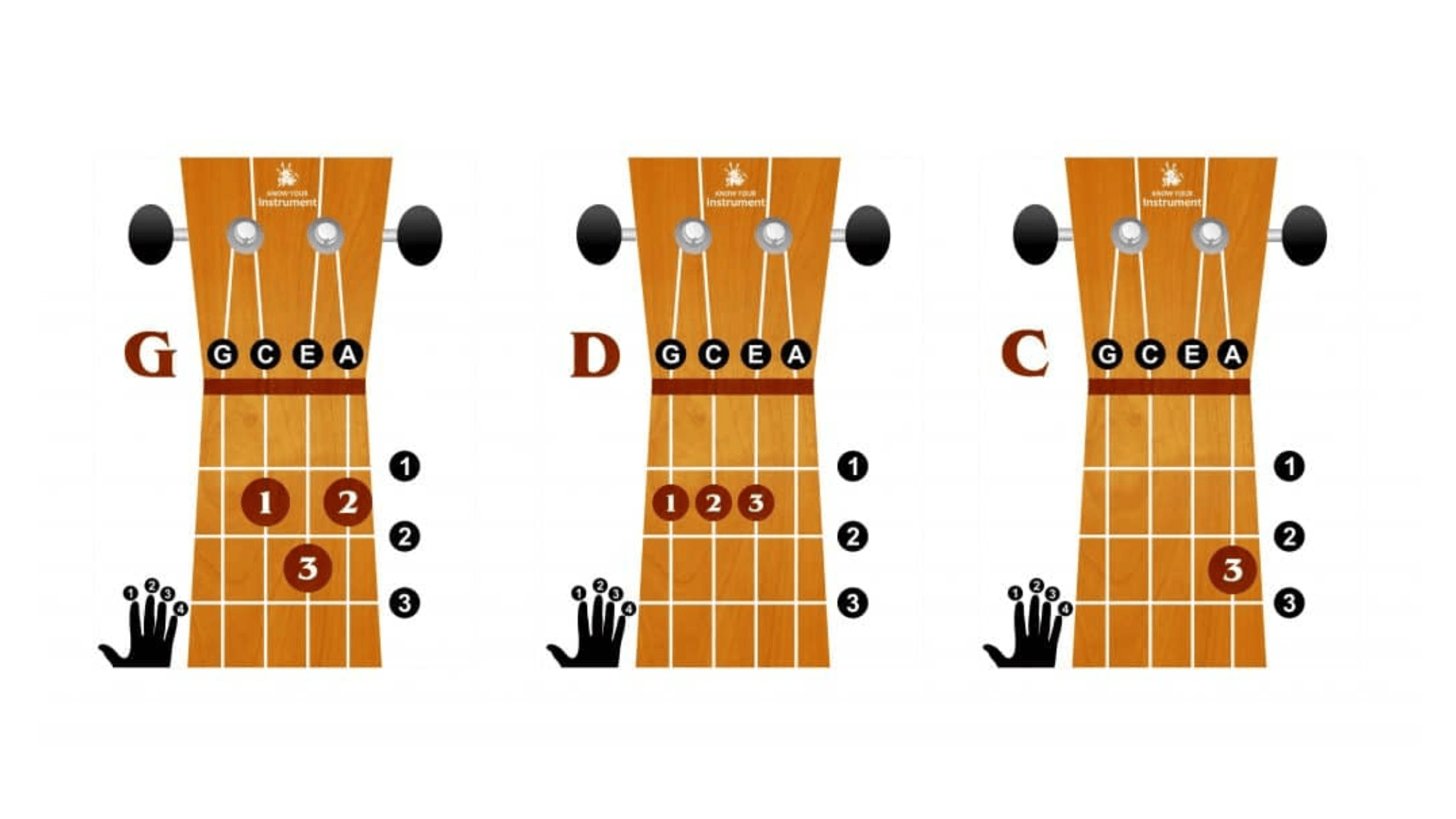
C Major (C) – The Easiest Ukulele Chord


Why it’s great for beginners:
Only one finger is required.
Finger Placement:
- Ring finger (3)
- 3rd fret on the A string
Strings played: G – C – E – A (all open except A string)
This chord sounds bright and is used in many beginner songs.
G Major (G) – A Core Beginner Chord

Finger Placement:
- Index finger (1): 2nd fret on C string
- Middle finger (2): 2nd fret on A string
- Ring finger (3): 3rd fret on E string
Tip:
Press close to the fret wire for a clean sound.
A Minor (Am) – Simple and Smooth

Finger Placement:
- Middle finger (2)
- 2nd fret on the G string
All other strings are open.
Am is one of the easiest minor chords and sounds great with slow strumming.
F Major (F) – Beginner Version

Finger Placement:
- Index finger (1): 1st fret on E string
- Middle finger (2): 2nd fret on G string
This is the simplified F chord, perfect for beginners.
D Major (D) – Small Shape, Big Sound

Finger Placement:
- Index finger (1): 2nd fret on G string
- Middle finger (2): 2nd fret on C string
- Ring finger (3): 2nd fret on E string
Tip:
Keep your fingers curved so they don’t mute other strings.
Common Beginner Chord Problems (And Fixes)
Buzzing Sound
- Press harder
- Move finger closer to the fret wire
- Keep fingers curved
Fingers Hurt
- This is normal at first
- Practice 10–15 minutes daily
- Pain reduces after 1–2 weeks
Slow Chord Changes
- Practice switching between two chords only
- Use a metronome or count slowly
Easy Chord Practice Routine (10 Minutes)
- C chord – 1 minute
- Am chord – 1 minute
- Switch between C and Am – 3 minutes
- G chord – 2 minutes
- Switch between C, G, and F – 3 minutes
Consistency matters more than long practice sessions.
Easy Songs You Can Play with These Chords
With just C, G, Am, F, and D, you can play:
- “Riptide” (simplified version)
- “You Are My Sunshine”
- “I’m Yours” (easy arrangement)
- Many traditional folk and kids’ songs
Final Thoughts
Learning beginner ukulele chords with proper finger placement builds a strong foundation. Don’t rush. Focus on clean sound, relaxed hands, and steady practice. Within a few weeks, you’ll be able to play full songs confidently.
If you stay consistent, the ukulele becomes one of the most rewarding instruments to learn.